Background Information.
Young And Mindful CIC (YaM) was set up in January 2022. as an urgent reponse to the effects of the pandemic on children and young people. Please read the report by following the link below:
https://phwwhocc.co.uk/whiasu/wp-content/uploads/sites/3/2021/08/Report-Alma-Economics-CYP-mental-wellbeing-during-Covid19-English-updated.pdf
The founder of YaM has been working in education for over 20 years and has seen the growing need for a wider approach to learning that includes mental, emotional and social wellbeing. YaM was set up to respond to students’ wellbeing needs as COVID-19 brought to the forefront the underlying mental and emotional issues experienced by many students that have invariably gone unaddressed in the past.
Having run two five-week pilot sessions for sixth formers at Ysgol Brynhyfryd, and received 500 questionnaires from three high schools in Flintshire, we knew our mindfulness sessions were a vital resource for schools. We had asked the young people: some of these important questions:
- What are the mental and emotional challenges your facing right now?
- If you need support for your mental and emotional wellbeing, where do you go?
- What does mindfulness look like to you?
- How would you feel about practicing mindfulness at school if it helped with your mental health and wellbeing?
The following themes stood out : 43% of young people said their biggest challenge right now was ‘coping with school life’. They wanted non-academic time, help with keeping calm, anxiety, exam stress, general pressure and pace of school life. 26% did not know where to access emotional & mental wellbeing support. 73% open to trying Mindfulness. 29% had a misconception of what mindfulness was.
The members of YaM have been engaged in mindfulness for many yearsand understand first-hand its positive effect on health and wellbeing.
Our wider objectives for this project were providing a positive experience of the course, a safe and calm environment in which to discuss, develop healthy wellbeing strategies to deal with school and social stressors, and a greater awareness of themselves and others, and developing resilience. All of which have a positive knock-on effect on their mental-emotional wellbeing.
What the Sessions Entailed:
The ‘.b’ course was 14-weeks in length, split into two phases. The 10-week phase contained the key concepts, different breathing techniques for reducing stress, as well as animations and videos for engagement. The 4-week phase was a recap to remind students of the key ideas they had learned. There was a cooling period of two months between the two phases to give students an opportunity to try out what they had learned and develop their own individual practice and to give them a break from the
intensity of the course.
Each session entailed some mindfulness practice, group or pair work and class discussion. The lessons were structured as follows: starting with a settling and relaxing technique, non-invasive enquiries regarding their home practice, introducing a theme and discussing their thoughts around it, watching an animation/video, asking for their key observations, and developing on their answers. The discussions were widened to include broader situations in school, home and society.
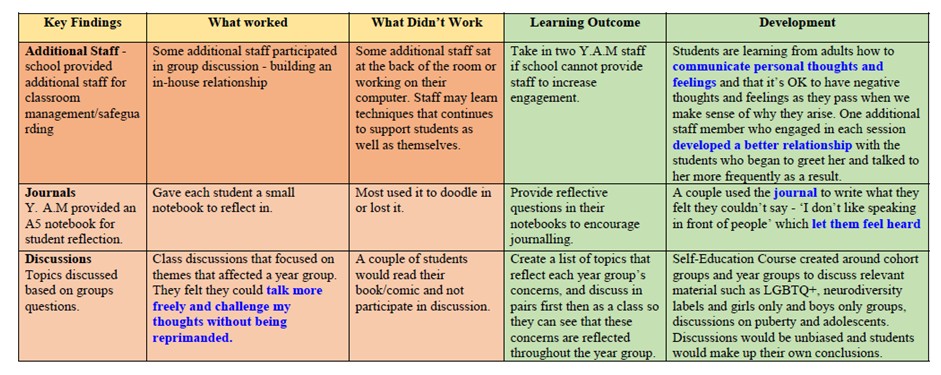
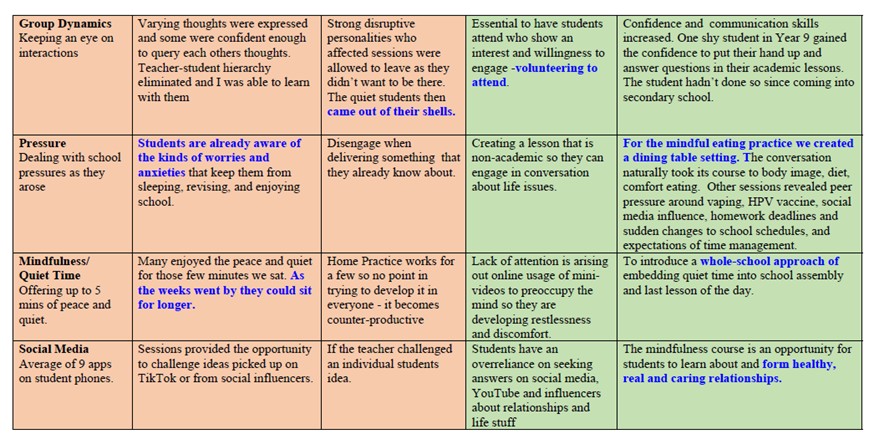
Key Findings.
Conclusion.
It was obvious that the high school students were interested in mindfulness but that the introductory course, which focused mainly on developing awareness and attention, had inbuilt limitations and that students had an interest in furthering their understandingof the factors involved in the adoption of beliefs and opinions and lifestyles and the way such came about, and the part that society played, in particular social media. A lengthier and broader course that deals in depth with students’ interests and is led by students’ interests and includesopen dialogue between students and also teachers is required. The students who thrived on dialogue had acquired a better understanding of themselves and how to listen to others too